What the Sahrawis want you to know about Africa's last colony
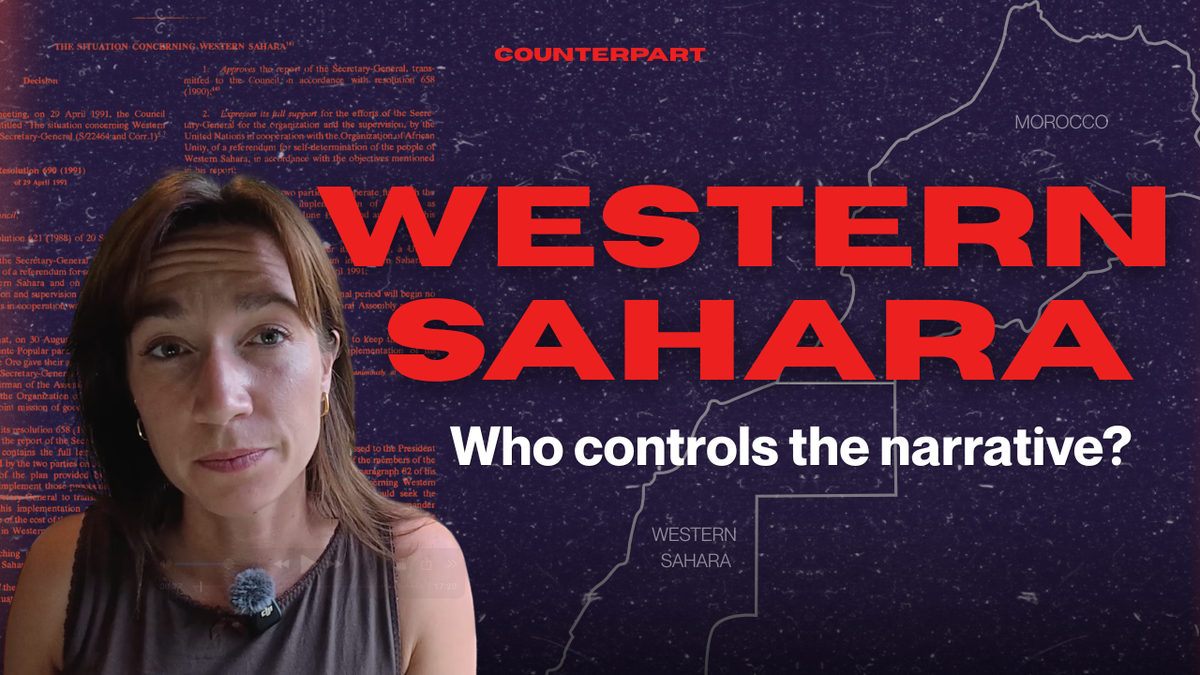
In this episode, we meet journalist Mohamed Mayara, co-founder of the independent journalism collective Equipe Media, who risks everything to report on the violent repression of Sahrawi activists by Moroccan authorities.
We also meet Najla Mohamed-Lamin, a women's rights and climate activist in the Sahrawi refugee camps of southwestern Algeria, where nearly 200,000 people still live in exile from their homeland of Western Sahara.
Watch below:
Articles and reports cited in video:
- Western Sahara Independence Group Ends Truce With Morocco (New York Times, 2020)
- Western Sahara: Polisario Front leader Abdelaziz dies (BBC, 2016)
- Three Polisario members killed in Western Sahara (Arab News, 2026)
- UK swings behind Morocco’s autonomy proposal for Western Sahara (The Guardian, 2025)
- US recognised Morocco’s claim to Western Sahara. Now what? (Al Jazeera, 2020)
- The Desert Rock That Feeds the World (The Atlantic, 2016)
- Morocco boosts military ties with Israel despite tensions (DW, 2026)
- Moroccan authorities expel human rights defenders Ahmed Ettanji and Mohamed Mayara from occupied Cape Bojador (Frontline Defenders, 2024)
- Morocco/Western Sahara: Crackdown against activists for criticizing the King, public institutions and officials (Amnesty International, 2020)
- Morocco deports 2 journalists trying to enter Western Sahara (Committee to Protect Journalists, 2025)
- EU backs Morocco autonomy plan for Western Sahara and eyes new partnership (RFI, 2026)
- Christopher Nolan’s Odyssey used occupied land as a film set. That feels like a betrayal (The Guardian, 2026)
- Morocco's Gaza deployment is reshaping its ties with Israel (Middle East Eye, 2026)
Episode Transcript
Najla Mohamed Lamin 00:00
It's not just, oh Morocco is evil. They took our land, and then we have to fight with ... no. This is part of a bigger game.
Mohamed Mayara 00:07
Could you imagine that? You being arrested just because you carry your camera? I think that this is how we are minority in their homeland.
Maxine 00:15
Six years ago, I saw a headline that sent me down a rabbit hole that continues to this day. Where was Western Sahara? Why hadn't I heard of it before? And what is it like to live through one of Africa's longest-running conflicts? My name is Maxine, and I'm a journalist based in London. This is Counterpart, a new series about underreported crises and the people living through them. The first episode of this series is about Western Sahara, where the indigenous Sahrawi people have been fighting for their independence from Moroccan occupation for more than 50 years. We are not Moroccans, and we will never be a part of Morocco. The story rarely makes international news headlines, and the situation is getting worse every day.
Najla Mohamed Lamin 00:54
To be honest with you, I'm not sure how long we still can live here. It's it's not easy.
Maxine 01:02
Through this series, I'm going to be introducing you to ordinary people and local journalists who are living through a crisis that you might not have even heard of. And if by the end of this video you're looking for a deeper dive into this crisis, check out the Counterpart website. That's where I'll be curating some of the best reporting on this subject from a number of different angles, along with media analysis to help you make sense of the coverage that does exist and make up your own mind about the situation. So let's get back to Najla. She's a Sahrawi refugee living in desert camps in southwestern Algeria near the town of Tindúf. The camps are officially known as the Sahrawi Arab Democratic Republic, which is the Sahrawi's official state in exile. Najla and I met on my first visit to the camps back in 2021, and we've stayed in touch ever since. Nagel was born and raised in the camps, and now she's the mother of two young children. For their family and 1000s of others, it's the only home they've ever known. On the day of our call, she got the news that three Sahrawi soldiers had been killed on the front line of the war with Morocco.
Najla Mohamed Lamin 01:55
When you told me when I got the news and you said, "Should we reschedule the the the interview? I was just thinking of, you know, it was. I was a bit worried, and of course, I'm. I'm sad, and I mean, this young man. He's a father, but I was also thinking, my God. I mean, this is to compare it with the Gazan death, you know, like constantly, like non-stop death, death, death. News of death. I'm not sure if it's if it's worth the news for people to know. I mean, and okay, no, and then what?
Maxine 02:32
One of those killed was 37-year-old Labib Mohammed Ablazeez. He's the son of the late leader of the Pulsario Front. This is the political military movement, which claims representation of the Sahrawi people, they've been fighting to liberate Western Sahara from Moroccan occupation for decades. So let me briefly explain, because there's already lots of YouTube videos out there about the history of this conflict, and there's a particularly good series from Sahrawi Voice, which I highly recommend you check out. Western Sahara is classified by the UN as a non-self-governing territory. It's also a former Spanish colony that Morocco invaded in 1975. This invasion triggered a 15-year war with the Pulitzerville Front, which is known as the Western Sahara War. The UN intervened in 1991 to broker a ceasefire agreement, which crucially included the promise of a referendum for self-determination for the Sahrawi people. Well, fast forward to today, and that referendum still hasn't happened. Meanwhile, Morocco continues to exploit the territory's vast array of natural resources for its own gain. Now we'll come back to what that means for Saharawi's living under Moroccan occupation in Western Sahara. But for now, let's go back to Nashua.
Najla Mohamed Lamin 03:32
The war is in Western Sahara territory, but it affects us directly because you know all the soldiers who are fighting in the front line, they are our brothers, our uncles, our husbands, our fathers. I mean, you could get the news any day that they they they they died. It's really painful to know that your loved ones have to go through this for something that shouldn't be shouldn't be so pricey, that shouldn't be so violent, you know. Especially having considering that we have given more than 30 years for something to to take place by political means and by diplomacy and by peaceful resistance, and still we have to sacrifice some of our youngest and best souls. I think one aspect that I always that I'm always thinking about, and I think it's very much not not talked talked about, is the price the Sahara people are paying, you know, and this whole political game, international political game, and I think also like these 50 years of our life, you know, all the invisible prices that we are paying from our life, from our health, from our future, of our children, of our rights. I mean, look at all all the people who have died here, not wanting to die here. The graveyard now is. Humongous of people who never wanted to, who never wanted to leave their land to begin with, let alone to be buried somewhere else.
Maxine 05:10
Climate change is also making the situation worse. Despite contributing virtually nothing to global carbon emissions, Sahrawis regularly experience its worst effects, from extreme weather to flooding and sandstorms this summer, temperatures have routinely soared above 50 degrees Celsius.
Najla Mohamed Lamin 05:25
I'm so insecure about my water resources. I'm so insecure that it's becoming like it's becoming like a trauma effect on my brain. I'm constantly thinking about how much water do I have? How can I use it wisely? How can I hide it? How can I protect it? Will I get water in the next month? You want to have a very balanced diet for your children. You want to have healthy snacks accessible to you for your children. What I have for my children is mostly bread. It's white bread, you know, when they are hungry, because I just cannot afford to have a balanced diet.
Maxine 06:07
My aim with Counterpart isn't to just expose you to another horrific crisis around the world and make you feel more helpless and more overwhelmed. Instead, I want to help you understand the perspectives of people that you might not otherwise hear from, and to hear what they say are some of the solutions to the crisis they're living through. Can you tell me about Almasar Centre and and sort of what the obstacles are in getting a project like this off the ground?
Najla Mohamed Lamin 06:31
Almasar Centre is it's a community space to help children with education, alternative education outside of the classroom and to help women around health issues, especially breastfeeding issues and breast cancer, and also a little bit of environmental program.
Maxine 06:51
Education is really, really important to the Sahrawis, and each of the local administrations in the camps run primary schools and health clinics. But Saharawis have to go to Tindúf for high school and university.
Najla Mohamed Lamin 07:01
Of course, children here they have schools, but children outside of the school they don't really have much spaces to flourish in, you know, exercise or to practice creativity or to you know read a book. I mean, reading books is relatively new to our community because we are mostly an oral culture, but above all, because I mean, reading books is not a priority when you are living in a refugee camp. So what we are trying to do is that to give these children a space away from the street, away from the screens, away from the house.
Maxine 07:36
Najal is doing this entirely independently, and she runs into so many obstacles just in the day-to-day running of the center.
Najla Mohamed Lamin 07:42
I mean, every NGO, every funder needs a direct and clear bank account. We don't have that. Every time somebody has to send money, I have to go through so many loops that so I have to ask a friend, a neighbor, somebody in Spain who have a bank account, they get money transferred to them, and then we have to find somebody who actually gives us the money physically here, or somebody doing the transfer by euros or dollars, and then we get the money here in dinars. And this makes our budget very low. I said I can do it without. I can continue doing this work without money, without getting money, but how much, how many people could benefit? You know, how many people could have access to this? We will continue, and we will navigate these difficulties in the best way possible for us.
Maxine 08:34
Until now, we've talked about the situation for Saharawis without actually taking you to Western Sahara. Here's why. International journalists are regularly denied entry into Western Sahara. Press freedom groups call it a news black hole, and it's ranked among the lowest in the world for civil liberties. But while international journalists can't get in, Sahrawi journalists are doing everything they can to get the story out.
Mohamed Mayara 09:01
My name is Mohamed Mayara, and I'm a political activist. I'm a human rights defender, and in the same time, I'm a journalist.
Maxine 09:07
I first met Mohammed in 2021 when I was doing research on digital activism and resistance filmmaking in occupied Western Sahara. He's the co-founder of Equipe Media, which is a collective of independent Sahrawi filmmakers that are doing some of the most important journalism under incredible pressures. Are you the only media outlet, only Sahrawi media outlet operating in Western Sahara right now?
Mohamed Mayara 09:27
So officially, yes, because there are some groups that they serve or they work with the Sahrawi national television or the radio, you know. But as independent, you know, group working with professional, you know, way as Equipe Media is still working.
Maxine 09:42
One of their films, Three Stolen Cameras, is about their fight to keep their cameras from confiscation from Moroccan authorities, and I really recommend you watch it. Growing up under the occupation, Mohammed says journalism felt like a calling.
Mohamed Mayara 10:05
When I was I was kid, I saw the Sahrawis how they hid from the Moroccan authorities in order to hear and to listen to the Sahrawi national radio because at that time it was a crime because many Sahrawis had been disappeared.
Maxine 10:18
The UN estimates that more than 1000 Sahrawis have been direct victims of prolonged enforced disappearance since the very first day of the occupation. Today, the whereabouts of at least 440 Saharawis are unknown, including Muhammad's own father.
Mohamed Mayara 10:32
My father was was kidnapped in 1976, and he was killed in the torture, and his fate is still unaccounted for. Now, he's in an unknown place. The Moroccans refuses to give me and the family the remains of my father, or to clarify his fate alongside with the scores of Saharas that they have been killed in horrible secret jail in Morocco.
Maxine 10:52
Mohammed says this is what made him want to be a journalist.
Mohamed Mayara 10:55
The media was was my dream, of course, but with my colleagues, I I I saw that the media was very with the core of the in the conflict because it it's a struggle between us and Moroccans about the narratives,
Maxine 11:10
And it's exactly this control over the narrative that impacts what you or I know about Western Sahara, and what we don't.
Mohamed Mayara 11:17
There is a massive presence of military and paramilitary in occupied Western Sahara. More than that, there are a lot of settlers there. They have been part of this Moroccan army in occupied Western Sahara to maintain the occupation. They give them all the possibilities in order to live in Western Sahara. They give them land, housing, etc. jobs, influence, and perjury. You know, but they move, they make Saharis and they improve Saharas more and more and more. Now I think that the Sahari are minority; they're homeland. So this is the situations. This is a systematic policy.
Maxine 11:52
Being a journalist trying to report on the situation in Western Sahara from inside Western Sahara is incredibly difficult, and Muhammad has repeatedly been targeted for his work
Mohamed Mayara 12:01
in 2024. I was targeted by a gang, ver longtempl Moroccan police. It's very, it's you know, kind of retaliations against us. More than that, there was friend of mine that part of co-founder of the Keep Media. They are still behind bars. They are in prisons, in Moroccan prisons since 2010. Could you imagine that you being arrested just because you cut in your camera, and you are still behind bars till 16 years, eight years? You are in a total confinement. You have no connection just with your guardians. So psychologically, I mean, think that the consequences is very severe for them, of course, you know. So four of my colleagues are still, you know, in Moroccan jails. Two of them are condemned by live imprisonment. This is kind of of the retaliations that we are suffer. We know the consequences, and we always say that, and we we pledged that we will never give up, of course, because because we are not criminals, we are you know journalists.
Maxine 13:07
If you're watching this from afar, you're probably thinking, okay, this is horrible. It's really unfair. But what has it got to do with me? Well, the situation in Western Sahara implicates many of us.
Najla Mohamed Lamin 13:18
It's not just oh, Morocco is evil. They took our land, and then we have to fight with no. This is part of a bigger game, and it's not only Morocco, you know, and it's not only the evil king who's doing this. It's a whole system that backs backs Morocco. It's a whole system that backs Israel, and it's a whole system that benefits and builds not only its basic needs, not only its basic rights, but its extreme luxurious privileges that they derive from these conflicts. And I think I think we need to expose this more, so that maybe people in the global north could see, okay, you are in a way responsible for this, whether you know it or not.
Maxine 14:03
Over the last few years, Morocco has been solidifying its control over Western Sahara. In 2020, the U.S. became the first country to formally recognize Moroccan sovereignty over Western Sahara as part of a Trump-brokered deal to normalize ties with Israel. Last year, the U.S. sponsored this resolution at the U.N. Security Council. As Morocco cozies up with Israel, it's also heavily promoting tourism in the territory, and there are ongoing campaigns to demand popular airlines like Ryanair don't fly to occupied Dakhla. But this hasn't deterred powerful people in Hollywood from seeking opportunities in Morocco, as we saw with the recent controversy around the filming of Christopher Nolan's *The Odyssey* in Western Sahara. Now, it's important to note that not all Moroccans support this occupation, but speaking out against the Moroccan king is incredibly dangerous, and we've seen many cases of crackdowns against activists in both Morocco and in Western Sahara over this and other issues. One of the most important things I've learned as a journalist reporting on this crisis from here in the UK is just how important local journalism really is. I mean, it shouldn't take. Big team of foreign reporters from the BBC or CNN, for us to care about what's going on here and for us to trust what local people are saying is happening. Of course, foreign journalists should be allowed into Western Sahara, and they should be allowed into any place that is under a media blockade anywhere in the world right now. But until then, I hope you'll look into more of the reporting from local Saharawi journalists themselves, and that you'll listen to what they're trying to tell us.
Mohamed Mayara 15:24
I want people to know that Western Sahara is still the last colony in Africa within the colonization. We are not a southern Morocco. We are the Sahrawi people, and we have a right to dissemination. Our resistance is peaceful, but it's meat with the violence, civilians, and the media blockade. This media blockade, of course, designed to erase us from the map. So please do not look away.
Najla Mohamed Lamin 15:49
I think it will be incredibly beautiful to have a society like a joyful, generous society that exists in the Atlantic Ocean between Morocco and Mauritania, welcoming visitors from all around the world. I think we have so much to contribute. Not that, not that I think we are obligated to prove anything to the world. I think we are worthy. I think we are worthy of this of this independence and of this stability and of this comfort. Nevertheless, I think we are a society that will contribute a lot. I think this is something beautiful that the world needs, which is diversity and acceptance and coexisting together, despite despite the differences and despite. What we can reject from the other and what we can accept.
Maxine 16:46
Thanks for watching this first episode of Counterpart, a new series about underreported crises and the people living through them. If you'd like to dive deeper into anything you heard from today's episode, check out the Counterpart website. It's where I curate all of the best reporting on the story from a number of different angles, alongside media analysis, to help you make sense of the coverage and make up your own mind about it. So, if you like this kind of content and you want me to make more episodes like it, please like and subscribe to the channel and tell your friends about it. It really helps other people to find the show. Thanks for watching. I'll be back.