Western Sahara: media analysis
Every episode of Counterpart comes with a curated guide to some of the best reporting on underreported crises, along with media analysis to help you make up your own mind about the situation.
If you haven’t already, please check out the latest episode of Counterpart on Western Sahara (it'll help everything below make sense):
TLDR;
- Western Sahara is a former Spanish colony that Morocco has occupied since 1975. It’s rich in natural resources like phosphates, fisheries and wind and solar energy
- The UN recognizes Western Sahara as a non self-governing territory awaiting decolonization. It has promised a referendum for self determination for the indigenous Sahrawi people since 1991
- The Sahrawis are represented by the Polisario Front, a political-military movement backed by Algeria, whose official state in exile is near Tindouf in southwest Algeria
- A 30-year ceasefire between Morocco and the Polisario ended in 2020, and war returned to the territory
- Sahrawis today live divided among the occupied territory, where they face violent repression and discrimination from Moroccan authorities; the refugee camps in southwest Algeria where around 200,000 people are largely dependent on humanitarian aid; and the diaspora
- Morocco has been aggressively lobbying governments around the world to recognize its “autonomy plan” over Western Sahara, which gives Sahrawis authority over local affairs, while Rabat retains jurisdiction over foreign affairs, defense and religious matters.
- In 2020, the US became the first country in the world to recognize Moroccan sovereignty over Western Sahara
- The status of the territory remains a diplomatic stalemate, but a growing list of countries are now backing Morocco's autonomy plan as a way to end the decades-long conflict
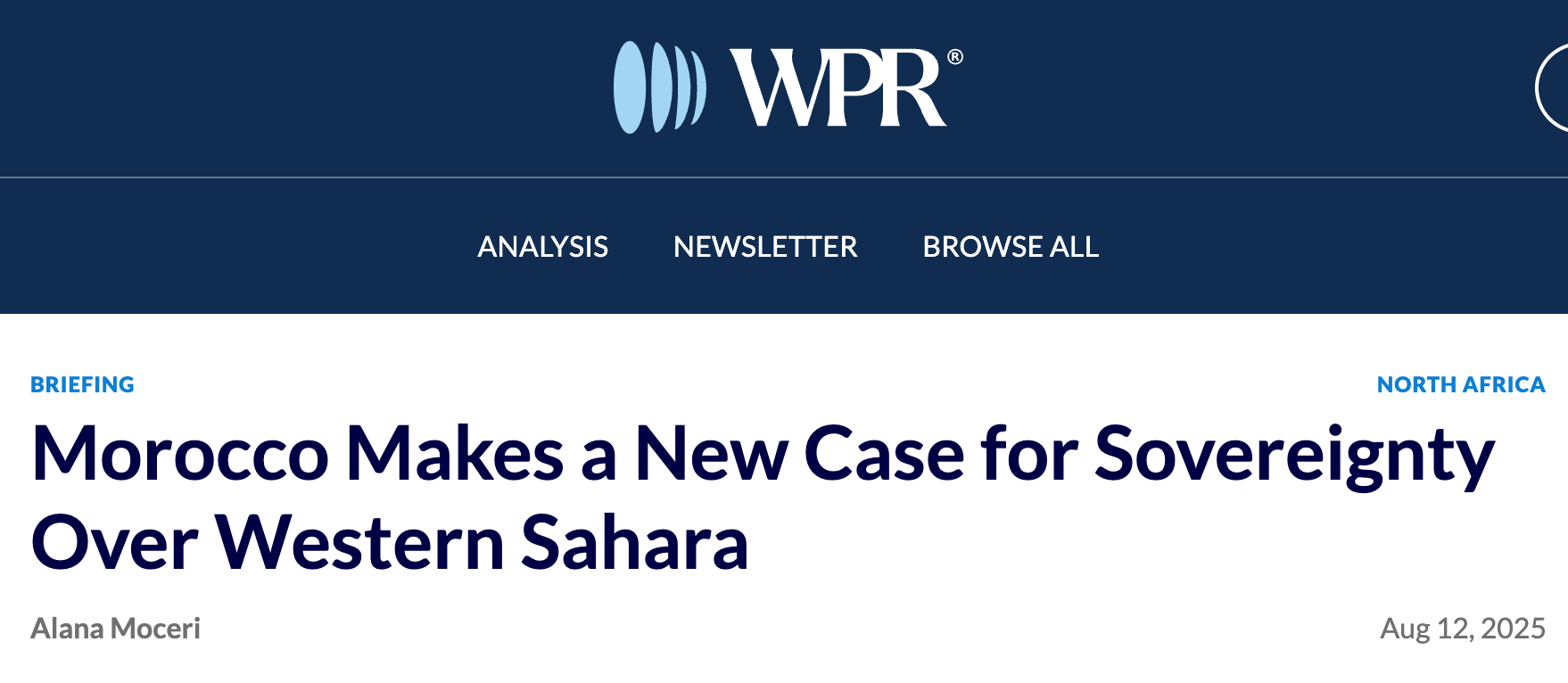
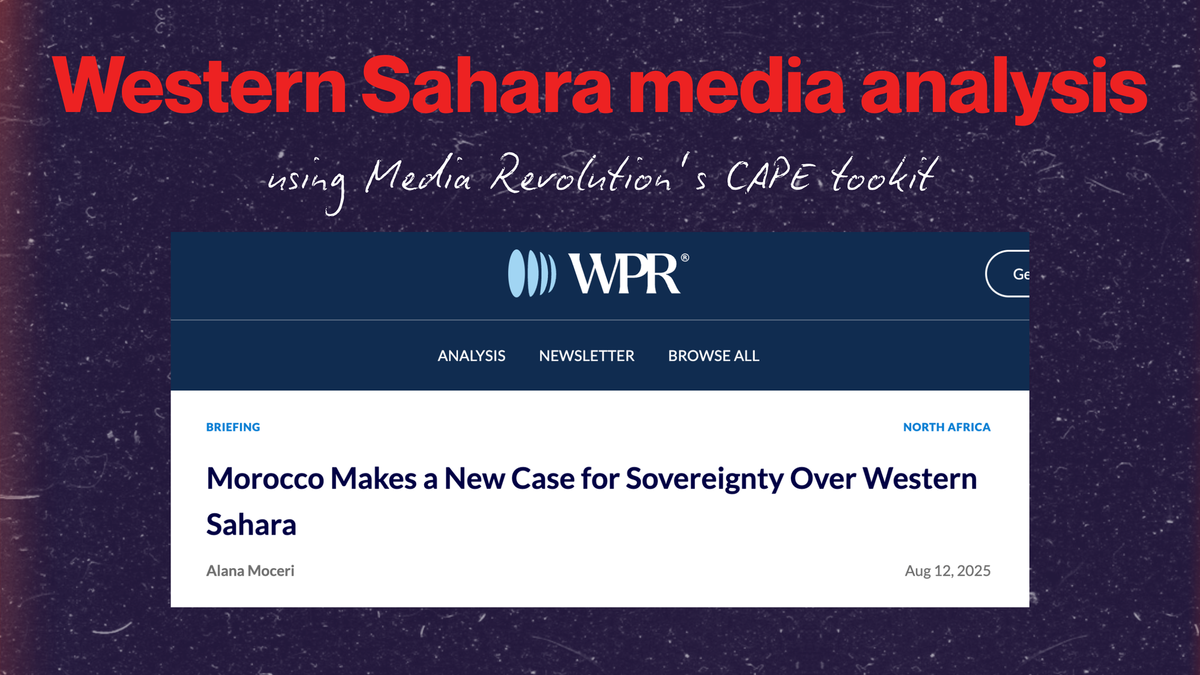
I'll be extracting and analyzing lines from this 2025 article in World Politics Review, which you can read here.
I chose to analyze this piece because of World Politics Review is nonpartisan and is widely considered to provide reliable and high-quality analysis on international affairs. It is often cited by universities, think tanks, and government agencies. According to the Media Bias Fact Check it has a left centre bias. The author, Alana Moceri, is an international relations professor at IE School of Politics, Economics and Global Affairs in Madrid, Spain.
For Counterpart’s media analysis of this and future articles, I’ll be using Media Revolution’s CAPE toolkit which examines articles through the lens of Content, Accuracy, Politics and Emotion (CAPE). The coloured blocks are paragraphs from the original article and I've colour coded them according to the CAPE toolkit. The text underneath is the analysis.
Let’s get into it.
The first line of the article reads ...
The term “dispute”, though commonly used, is misleading because it obscures the Sahrawis’ right to self-determination, which is enshrined by several international laws.
Trump was the first world leader to recognize Morocco’s autonomy plan as part of a US-sponsored agreement known as the Abraham Accords which saw several Arab states, including Morocco, normalize ties with Israel.
CAPE = CONTENT
These countries didn't endorse the plan out of the blue – rather, Morocco has been pursuing an aggressive lobbying campaign to gain international support for its autonomy plan for years.
An international investigative journalism project known as The Pegasus Project, revealed that Morocco used Israeli Pegasus spyware to target Spanish prime minister Pedro Sanchez and his defense minister during a diplomatic crisis over Western Sahara in 2021. Then in 2022, Spain officially recognized Morocco’s autonomy plan. This paragraph also omits the fact that the Sahrawi Arab Democratic Republic is a full member of the African Union, recognized by dozens of countries around the world.
CAPE = CONTENT
The occupation is referred to in the past tense, which implies it's over, though the article doesn't mention how or when. This line also doesn’t mention that Morocco used napalm and cluster bombs on the Sahrawi population during its invasion, forcing mainly women and children to flee into neighbouring Algeria to seek refuge. The UN-brokered ceasefire promised a referendum for self-determination for the Sahrawi people but fighting broke out again in 2020 and has continued sporadically ever since.
CAPE = CONTENT/ACCURACY
The piece omits details of Morocco’s diplomatic and military support from the US and Israel.
CAPE = CONTENT
The Polisario Front has also denied this. In October 2025 the UK government said it has “not seen evidence of Iranian support for the Polisario Front”.
CAPE = ACCURACY/EMOTION
The Policy Center for the New South is a think tank that refers to Western Sahara as the “Moroccan Sahara”. The Dakhla Atlantic Port is part of the Moroccan government’s development plans for what it calls its “southern provinces” and rights groups have asked international companies not to invest without explicit consent from the Sahrawi people.
CAPE = POLITICS
Journalists should be highly skeptical of any government’s invitation to “show off” anything, particularly when it is in a location that has been subjected to more than 50 years of military occupation. Those 1,500 workers are almost certainly Moroccan and/or foreign. See this piece about the denial of employment opportunities to Sahrawis living under Moroccan occupation.
CAPE = POLITICS/CONTENT
This economic integration strategy is already bearing diplomatic fruit. The U.K.’s endorsement of Morocco’s autonomy plan for Western Sahara in June wasn’t just a diplomatic shift but part of an economic strategy to deepen trade ties with Morocco and expand markets for British companies.
This section requires a bit of background to understand why the UK and others are eyeing up Western Sahara as a "regional gateway": In the first case of its kind in 2015, lawyers acting on behalf of the Western Sahara Campaign UK (WSCUK) argued that products originating in the Sahara and imported into the UK are being wrongly treated as Moroccan and that British government departments are illegally benefiting from preferential tariffs granted to Morocco by the EU. The High Court ultimately dismissed the case, but in 2021, the Court of Justice of the European Union (CJEU) blocked efforts by the European Commission to include the territory in the European Union’s trade agreements with Morocco.
CAPE = CONTENT
This one is easily missed - but the term “local populations” is skewed by the fact that Morocco has resettled hundreds of thousands of its citizens into Western Sahara. It’s an ongoing dispute around voter eligibility should a referendum ever take place.
CAPE = ACCURACY/POLITICS:
Morocco is now set to co-host the 2030 FIFA World Cup along with Spain and Portugal, and as the date nears, additional economic partnerships for development and infrastructure will be up for grabs. The British government noted this in June, stating that its new trade agreements with Morocco would put British companies at “the front of the queue” when bidding on World Cup-related infrastructure projects.
With so much money swashing around, it’s easy to forget about the refugee camps in Tindouf, in southwestern Algeria, which have been home to some 173,000 Sahrawi refugees for five decades. Under the control of the Polisario Front, these camps are rife with human rights abuses. Particularly disturbing is the plight of Sahrawi women refugees, who have faced gender-based violence, forced marriages and restrictions on movement and speech. Yet neither Morocco nor Algeria has taken significant steps to alleviate their suffering, and according to a recent U.N. report, the international aid that is directed toward the Sahrawi people is siphoned off by the Polisario Front.
The “UN report” she cites here isn’t a UN report – it’s “Meetings Coverage” of a June 2025 session. The link to gender-based violence is presented as fact here, but links only to a question on this subject that was posed to the EU Commission by representatives of the rightwing European Conservatives and Reformists Group.
This isn’t to say that gender-based violence isn’t taking place in the camps – around the world, women are at heightened risk of sexual and gender-based violence in conflict and humanitarian settings. But the article doesn’t include evidence or testimony, and it fails to mention that Sahrawi women enjoy a high degree of autonomy and authority in the camps.
The accusation of aid being “siphoned off by the Polisario Front” is made by a man named Zine El Aabidine El Ouali, a Sahrawi who is affiliated with Association 9 Mars, a Moroccan civil society organization advocating around human rights abuses in the Tindouf camps. There is no official evidence of this claim.
CAPE = ACCURACY/CONTENT
For now, Morocco’s campaign for Western Sahara to be recognized as its southern provinces seems unstoppable.
The word “unstoppable” here implies that the referendum for self-determination will never happen.
CAPE = EMOTION
Rabat’s realpolitik approach has proven to be enormously successful in convincing a large part of the world of the inevitability of its sovereignty over Western Sahara. But dialogue and partnership with Sahrawi women activists and other civil society actors may be the key to bringing about a peaceful integration of the territory.
Within 45 seconds of the linked video, Amy Goodman of Democracy Now makes it clear that the women’s plight is that of: “women who have been subjected to sexual violence, political violence by the Moroccan occupation of Western Sahara.”
Also highly emotional language including enormously “successful” and “inevitability”.
CAPE = ACCURACY/EMOTION
What do you think of the media analysis above? Please share your thoughts below.
And don't forget to check out Counterpart's (non-exhaustive) guide to the best reporting on Western Sahara.
 Maxine Betteridge-Moes